The Twelve Who Were Always Meant to Be: A Hadith That History Could Not Bury
There are moments in history when the truth is so powerful, so structurally undeniable, that its opponents resort not to argument — but to noise. Literal noise. According to multiple narrations, when the Prophet Muhammad ﷺ rose to speak these particular words — at Hajjat al-Wida, in the sacred precincts of Mecca, in front of thousands — certain companions stood up and caused such a commotion, such deliberate chaos, that his voice could not reach the ears of those farther away. The crowd was disrupted. The hadith was blurred in transmission.
And yet, it survived. It made it into Bukhari. Into Muslim. Into every major collection of Sunni Islam. It circulated through Shia sources with equal force. It refused to die.
That hadith — the Hadith of the Twelve Successors — is the subject of this discussion. But more than the hadith itself, what we are examining here is the elaborate intellectual architecture that has been constructed over centuries to avoid its most natural, most logically consistent conclusion.
Why would anyone work so hard to suppress a hadith at the moment of its utterance — unless they already understood exactly what it meant, and exactly what it would demand of them?
A Hadith So Certain, Even Its Opponents Cannot Deny It
Let us begin with a simple, incontrovertible fact: this hadith is mutawatir by any reasonable standard – narrated through so many parallel chains that fabrication is ruled out by the very laws of probability.
The Prophet ﷺ spoke these words — not once, not ten times, not even twenty. He repeated them in varying formulations, at different times, in different places, using different terms:
يَكُونُ مِنْ بَعْدِي اثْنَا عَشَرَ أَمِيرًا
“After me, there will be twelve commanders (Amirs).”
📚 Sahih al-Bukhari & Sahih Muslim
لَا يَزَالُ الدِّينُ عَزِيزًا مَنِيعًا إِلَى اثْنَيْ عَشَرَ خَلِيفَةً
“This religion will remain strong and unassailable until twelve caliphs (Khalifahs).”
📚Sahih Muslim
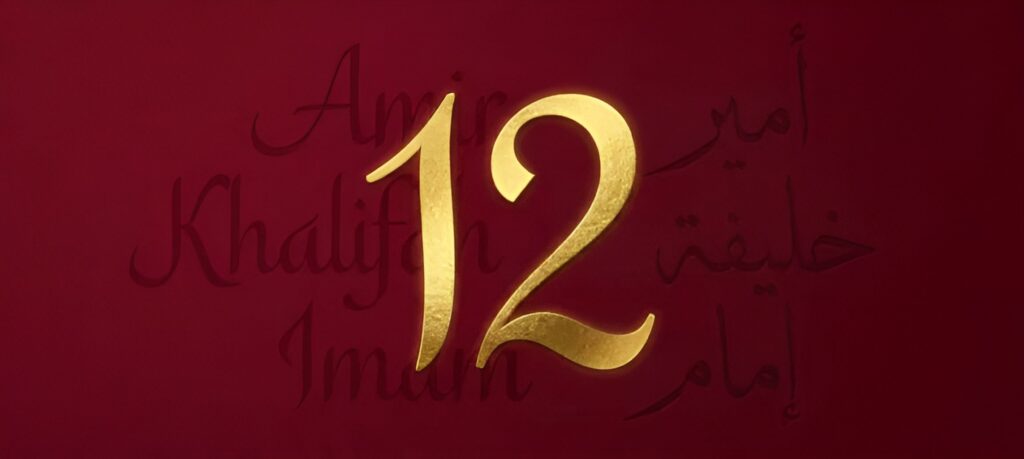
Sometimes he said Amir. Sometimes Khalifah. In certain narrations, Imam. The number never changed. The spirit never wavered. This is not coincidence – it is a pattern that the Prophet ﷺ deliberately and consistently maintained.
The Wahhabi Objection – And Why It Defeats Itself
Now, there is a popular objection raised from certain Wahhabi and Salafi circles, and it goes something like this: “The Prophet said ‘twelve Khalifahs’ or ‘twelve Amirs’ – he did not say ‘twelve Imams.’ So this hadith cannot be used to support the Shia claim of twelve Imams.”
At first glance, this might seem clever. But think carefully about what is actually being argued here.
The claim is essentially this: that Imam, Khalifah, and Amir are mutually exclusive categories — that a person cannot simultaneously hold all three titles, and therefore the use of one title negates the others. This is, to put it plainly, a logical fallacy.
Consider a real-world example before we return to the theological one. A man may be simultaneously a father, a husband, a CEO, and a citizen. Calling him a “CEO” in one context does not mean he ceased to be a father. The titles describe different dimensions of the same reality. So too with the Ahlul Bayt: their Imamate, their Khilafah, their position of Wilayah, and their authority as Amirs are not competing designations. They are complementary dimensions of a single, elevated station.
But let us go further. Let us look at one of the most illuminating examples in all of religious history.
Prophet Abraham: The Imam Who Was Never Called “Imam”
Open any collection of Sunni hadith literature – including Wahhabi and Salafi sources – and search for the phrase “Imam Ibrahim” or “Qala al-Imam Ibrahim” (the Imam Ibrahim said…). You will find nothing. Not one instance of the Prophet ﷺ using that phrase in narrated speech.
Does that mean Abraham was not an Imam?
The Quran answers this explicitly:
Abraham’s Imamate is Quranic truth. Yet the title “Imam” was rarely affixed to his name in the prophetic oral tradition – because the primary titles used for him were Nabi (Prophet) and Rasool (Messenger). The non-use of a title is not evidence of the non-existence of the reality it describes.
Applying this logic to the Ahlul Bayt: the fact that the Prophet described them as “twelve Khalifahs” does not negate their Imamate. It illuminates another facet of it.
Khalifah: Not a Crown You Inherit From Power
This brings us to a deeper and profoundly important theological point — one that strikes at the very heart of how Sunni political theology has been distorted to legitimize historical power grabs.
In the Wahhabi understanding, Khalifah is essentially a political category: whoever holds power, whoever governs, is the Khalifah. The logic flows from power to legitimacy. If you rule, you are the Caliph.
But the Quranic and prophetic tradition runs in the opposite direction.
The Quran speaks of Prophet David:
Notice the sequence: God made David a Khalifah — and therefore he judged (governed). The Khilafah is the origin; governance is the result. Governance flows from Khilafah, not the other way around. A person must be a Khalifah first — in the divine, ontological sense — for their governance to be legitimate.
And consider Prophet Adam, peace be upon him. God declared:
At that moment, Adam had no state. No army. No treasury. No subjects. His “government” — if we can even use the word — consisted of himself and his wife. Yet God called him a Khalifah. The title had nothing to do with political power.
This completely demolishes the Wahhabi logic: that Muawiya was a legitimate Khalifah because he ruled, or that Yazid was a legitimate Khalifah because he inherited power. If governance does not produce Khilafah — only flows from it — then their rule was not Khilafah. It was, at best, governance without divine sanction. At worst, usurpation.
The formula is simple: a person must be the Khalifah in order for their rule to be legitimate. If the Khilafah is absent, the rule is invalid. The converse — that ruling makes one a Khalifah — is, to use a word that is both appropriate and precise, absurd.
Ibn Kathir Himself Breaks Ranks
Now we arrive at a remarkable moment — one that every sincere reader, regardless of their tradition, should sit with in honest reflection.
Ibn Kathir al-Dimashqi. Student of Ibn Taymiyyah. One of the most celebrated Salafi scholars in Sunni history. A man whose name is invoked constantly in conservative Islamic circles as an authority of the highest order.
In his magnum opus — Tafsir al-Quran al-Azim (The Exegesis of the Magnificent Quran), published by Dar al-Taybah — in the third volume (al-Juz’ al-Thalith), Ibn Kathir comments directly on the Hadith of the Twelve. His words:
Stop there. Ibn Kathir — the Salafi scholar — says explicitly that all twelve must be righteous (Salih). This single sentence demolishes a critical Wahhabi counter-argument: that the Prophet’s mention of “twelve” did not require those twelve to be people of virtue. Ibn Kathir says otherwise. He says the very meaning of the hadith is a prophecy of twelve righteous successors.
And then — in a moment of extraordinary candor — he continues:
Ibn Kathir — a student of Ibn Taymiyyah — is telling us, without ambiguity:
- The twelve must be righteous individuals.
- The Mahdi is specifically one of these twelve.
- The Mahdi will be so significant that Jesus (Isa) ﷺ will pray behind him — a detail mentioned in connected narrations that Ibn Kathir acknowledges.
This is not a Shia source interpreting a Sunni hadith. This is a Salafi scholar’s own interpretation of a Prophetic hadith — and it leads, step by step, in a direction that Salafi circles today would find deeply uncomfortable.
The Title That Changes Everything: Khalifatullah al-Mahdi
We arrive now at a narration of breathtaking significance.
In Al-Mustadrak ala al-Sahihayn by Imam al-Hakim al-Naysaburi — the great hadith master and critic — in the fourth volume (al-Juz’ al-Rabi’), page 51, published by Dar al-Kutub al-Ilmiyyah, the following narration appears:
Read that again slowly. Khalifatullah. The Caliph — the Vicegerent — of God Himself. This is not merely a political title. This is a divine ontological designation. The same category applied to Adam, to David, to Abraham — now applied to the Mahdi, who Sunni tradition itself places at the end of time as the final restorer of justice.
And what did al-Hakim say about this hadith’s authenticity?
And al-Dhahabi — the master hadith critic who was himself no friend of Shia theology — confirmed it in his Talkhis, stating it meets the standards of al-Bukhari and Muslim both.
A hadith, graded Sahih by al-Hakim, confirmed by al-Dhahabi, calls the Mahdi by the title Khalifatullah. And it commands Muslims to seek him out — even crawling through snow — and give him their allegiance.
This narration does not merely support the Shia theological position. It demands a question from every honest reader: if the Mahdi is the Khalifatullah, and if he is among the twelve Khalifahs prophesied by the Prophet ﷺ, then who are the other eleven?
The Nuqaba of Moses: A Parallel That Confirms Righteousness
Now comes a narration that seals the argument about the moral character of these twelve — narrated not once, but confirmed through multiple independent chains.
A man came to Abdullah ibn Masud — one of the most trusted companions of the Prophet ﷺ — and asked:
“How many caliphs will govern this nation?”
Ibn Masud replied — and note that he attributed this directly to the Prophet ﷺ:
This narration, with a Hasan (sound) chain of transmission, appears in three independent major Sunni works:
- Al-Sawa’iq al-Muhriqah by Ibn Hajar al-Haytami — Volume 1, Page 54 — Published by Dar al-Watan, Riyadh, Saudi Arabia.
- Al-Matalib al-Aliyah bi Zawa’id al-Masanid al-Thamaniyah by Ibn Hajar al-Asqalani — Volume 9 (al-Mujallad al-Tasi’), Part 17-18, Page 577 — Tahqiq: al-Sa’di, Dar al-Asima lil-Nashr wal-Tawzi.
- Tarikh al-Khulafa by Imam al-Suyuti — Page 75 — Published by the Ministry of Awqaf and Islamic Affairs, Qatar.
In the version preserved by Ibn Hajar al-Asqalani, the wording is even more explicit:
Now — who were the Nuqaba of Moses? They were twelve men chosen by divine command to lead the twelve tribes of Israel. They were men of spiritual standing, of moral rectitude, of religious authority. They were not random administrators or tribal strongmen who happened to acquire power. They were chosen, designated, and morally qualified leaders.
By drawing this parallel, the Prophet ﷺ embedded into this hadith a built-in criterion of righteousness — a criterion that no honest scholar can simply argue away.
Three chains of transmission. Three major Sunni scholars. One consistent message: twelve leaders, like the twelve leaders of Moses — and those leaders were known for their righteousness.
The Unanswerable Challenge
Here is where the intellectual honesty of every reader — regardless of their tradition — is put to its severest test.
The Wahhabi narrative claims that Shia scholars, after the occultation of their twelfth Imam, went searching through hadith literature, happened upon these “twelve” hadiths, and retroactively constructed their theology around them. In other words: the conclusion came first, and the evidence was cherry-picked to suit it.
This is a serious charge. And it demands a serious response.
The response is this: produce a single hadith in which the Prophet ﷺ mentions a number of successors or leaders other than twelve.
Not fourteen. Not nine. Not thirty. Not seven. One hadith. Any hadith. With any chain of transmission. In which the Prophet ﷺ names the count of his successors as anything other than twelve.
Every narration — across Bukhari, Muslim, Ahmad, al-Tirmidhi, and every major collection — gives the same number: twelve. Uniformly. Without a single exception on this specific question of successorship.
If Shia scholars invented the connection between this hadith and their twelve Imams, they did so by somehow ensuring that every authentic Sunni hadith on the subject would, independently and consistently, land on the same number. That is not a conspiracy. That is a miracle of coincidence so improbable it collapses under its own weight.
The number twelve was not constructed around the twelve Imams. The twelve Imams are the answer to the question the Prophet’s ﷺ number has always been asking.
Why Can’t Sunni Scholars Complete the List?
Ibn al-Jawzi, one of the great Sunni hadith scholars and jurists, wrote with remarkable candor about this hadith. He and many of his colleagues admitted — openly, in writing — that they had spent years trying to identify who these twelve successors were, and had failed to arrive at a satisfying answer.
This admission is itself a form of evidence. Because the Sunni historical lists are notoriously incoherent:
- Some begin with Abu Bakr, Umar, Uthman, Ali — the four Rightly-Guided Caliphs.
- They then include Muawiya — who warred against Ali and whose legitimacy is deeply contested even within Sunni scholarship.
- They then include Yazid ibn Muawiya — the man under whose orders Imam al-Husayn was killed at Karbala. Even mainstream Sunni scholars curse Yazid. Including him among “twelve blessed leaders” is theologically untenable.
- Then they skip across centuries to Umar ibn Abd al-Aziz, jumping over multiple rulers, before arriving at…
- The Mahdi — whose identity, timing, and lineage they then dispute amongst themselves.
> Review the Dark Triad psychological profiles and clinical Machiavellianism of the Umayyad dynasty.
This is not a coherent narrative. It is a list stitched together from historical scraps, hopping over figures who contradict the criteria the Prophet ﷺ set, collapsing under the weight of its own inconsistencies.
Meanwhile, the Shia position offers twelve names — sequential, connected, from one family, across a specific period of time — all of whom share the same moral profile, the same role, and the same lineage the Prophet ﷺ pointed to repeatedly in hadiths about the Ahlul Bayt.
The choice is not between two equally credible interpretations. It is between a coherent answer and a perpetually incomplete puzzle.
The Suppression at the Moment of Utterance
Return, now, to where we began. The scene at Mecca. The Prophet ﷺ speaking. Certain companions rising, making noise, drowning out the words before they could spread.
Recall also the Day of Thursday (Yawm al-Khamis) — when the Prophet ﷺ, in his final illness, asked for pen and paper to write something that would prevent the nation from going astray, and was again prevented by commotion and dispute. The pattern is the same: words that threatened a particular political order were suppressed at the source.
But here is the enduring miracle: even through those attempts at suppression, the hadith of the twelve — in all its versions — survived intact in the very books that those same political actors’ intellectual descendants would later canonize as sacred. Bukhari recorded it. Muslim recorded it. They had no choice. The chain of transmission was too strong, the narrators too many.
A hadith they tried to bury at its birth ended up preserved in their own most authoritative collections. History, at least in this instance, has a sense of justice.
The Lock and the Only Key That Fits
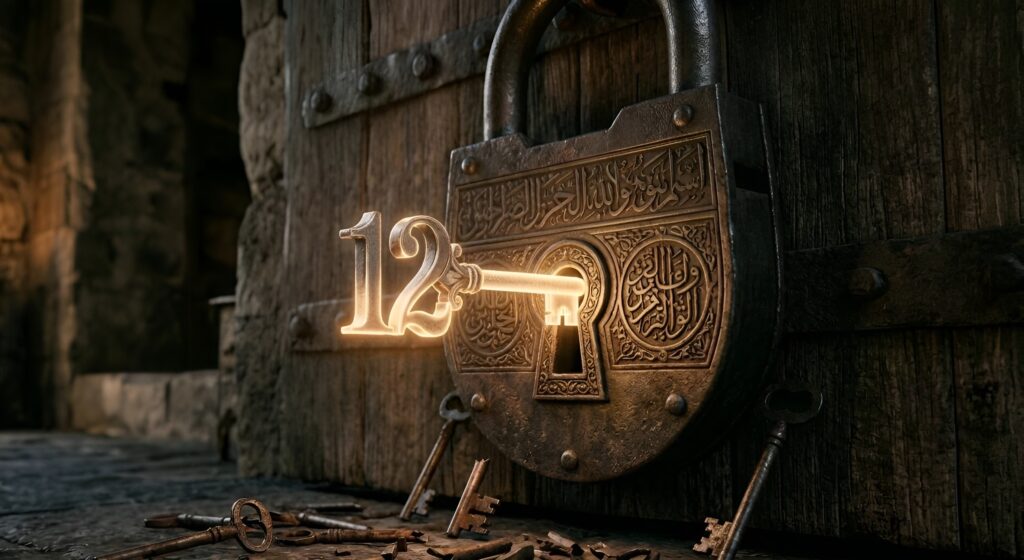
There is a powerful image worth sitting with.
A lock, any lock, has a specific internal mechanism. You can try any key you like. You can try the most ornate key, the most expensive key, the key of the most powerful person in the room. If it is not the right key, the lock will not turn.
The Hadith of the Twelve Successors is such a lock. It has specific internal criteria:
- The successors must number exactly twelve — no more, no less.
- They must be righteous (confirmed by Ibn Kathir himself and by the comparison to the Nuqaba of Moses).
- Their existence must be tied to the glory and honor of Islam in a direct, causal relationship — not a coincidental one.
- One of them must be the Mahdi, designated as Khalifatullah.
- They must come from the Prophet’s own household — a criterion confirmed by dozens of other hadiths about the Ahlul Bayt, from Sahih Muslim alone.
Every alternative key that has been tried — the Umayyad list, the Abbasid list, the eclectic Sunni compilation — has failed to turn this lock. Scholars of the stature of Ibn al-Jawzi said so themselves.
Only one key has ever fit: the twelve Imams of the Ahlul Bayt, from Ali ibn Abi Talib to Muhammad ibn al-Hasan al-Mahdi.
A Final Word to the Sincere Reader
This article is not written as an attack on any tradition, and it is not asking anyone to abandon their convictions lightly. Matters of faith are serious, and serious matters deserve serious engagement.
What it is asking — of the Sunni reader, the Wahhabi reader, the skeptic, and the seeker alike — is this: sit with the evidence. Not the polemics. Not the politics. The actual texts, the actual citations, the actual words of your own scholars.
Ibn Kathir said the twelve must be righteous, and that the Mahdi is among them.
Al-Hakim said the Mahdi is Khalifatullah, and al-Dhahabi confirmed it on the standards of Bukhari and Muslim.
Ibn Mas’ud — a companion of the Prophet ﷺ — said their number is like the Nuqaba of Moses: twelve, righteous leaders, chosen for a purpose.
And the Prophet ﷺ himself — not once, not ten times, but repeatedly, with different words, in different places — pointed to the number twelve.
These voices are not coming from Qom or Najaf. They are coming from Damascus, from Nishapur, from Mecca and Medina, from the very libraries that Sunni and Salafi Islam holds most dear.
The hadith survived suppression. The sources speak. The only question now is whether we are willing to listen.
Source Index
| Source | Author | Details |
|---|---|---|
| Sahih al-Bukhari | Muhammad ibn Ismail al-Bukhari | Hadith of the Twelve Amirs |
| Sahih Muslim | Muslim ibn al-Hajjaj al-Naysaburi | Hadith of the Twelve Khalifahs |
| Tafsir al-Quran al-Azim | Ibn Kathir al-Dimashqi | Vol. 3 (al-Juz’ al-Thalith), Dar al-Taybah |
| Al-Mustadrak ala al-Sahihayn | Al-Hakim al-Naysaburi | Vol. 4 (al-Juz’ al-Rabi’), p. 51 — Dar al-Kutub al-Ilmiyyah |
| Al-Sawa’iq al-Muhriqah | Ibn Hajar al-Haytami | Vol. 1, p. 54 — Dar al-Watan, Riyadh |
| Al-Matalib al-Aliyah | Ibn Hajar al-Asqalani | Vol. 9 (Juz 17-18), p. 577 — Dar al-Asima |
| Tarikh al-Khulafa | Jalal al-Din al-Suyuti | p. 75 — Ministry of Awqaf, Qatar |
Deep Psychological, Neurological & Sociological Analysis
Deep-dive analyses exploring the neurological, psychological, and sociological mechanics behind the historical transmission and suppression of the Hadith of the Twelve.
The Neuroscience of Pre-Emptive Suppression: Identity-Protective Cognition in Crowds
The question the article raises here — why suppress something unless you already understand it? — deserves a more penetrating answer than rhetoric can supply. What we are observing in this scene at Hajjat al-Wida is not mere impulsiveness, not ignorance, and not piety. It is something that modern psychology and neuroscience can name with clinical precision: pre-emptive narrative disruption, executed under the pressure of an acute identity threat.
To understand the psychology of the companions who stood up to create commotion during this specific utterance, we must first establish a crucial fact that historians often gloss over: you do not disrupt speech you do not understand. The very act of recognizing the moment — knowing this is the statement that must not clearly reach the crowd — requires prior comprehension of the stakes. These individuals did not create noise because they were confused. They created noise because they understood. This is one of history’s most painful ironies: the suppression of the hadith is itself proof of its comprehension.
From a neurological standpoint, what we are observing can be mapped onto what researchers now call identity-protective cognition — a well-documented phenomenon in which the brain, when processing information that threatens a deeply held identity or group-membership, shifts its processing from the prefrontal cortex (the seat of rational analysis) to the amygdala (the brain’s threat-detection center). Studies published in Nature Scientific Reports (Kaplan et al., 2016) using fMRI imaging have demonstrated that when participants encounter arguments that threaten strongly held beliefs, the brain’s default mode network activates, and simultaneously, regions associated with emotional reasoning override analytical processing. The subject does not reason against the threatening information — they react against it. The reaction precedes the argument.
This is exactly what we observe in the scene at Mecca. The Prophet ﷺ had not finished his speech. The full content had not yet been transmitted. Yet the disruption began. This is not the behavior of people conducting a rational theological evaluation. This is the behavior of people whose amygdalae had already fired — who felt the existential threat before the words were complete. It tells us that some of those present had already privately wrestled with the implications of the “twelve” framework and had already — consciously or unconsciously — decided where their interests lay.
From a sociological perspective, the scene maps onto what Erving Goffman called impression management at the group level: when a public statement threatens the social order, those with the most to lose from the new information are also the ones most motivated and most positioned to control its reception. The companions who disrupted the speech were not random members of the crowd — they were among the inner circle, those close enough to hear it beginning and powerful enough to silence it. Sociological power and proximity converged at precisely this moment, and the result was the partial blurring of a transmission that, as the article notes, survived despite their efforts.
There is also a darker dimension worth naming directly. What occurred was a form of collective gaslighting — the deliberate introduction of chaos to prevent clarity, so that those farther away would be left with ambiguity rather than certainty. In clinical contexts, gaslighting is typically described as an interpersonal manipulation technique by which an abuser creates confusion and doubt in their target’s perception of reality. When done at scale — through social noise, contradicting reports, and manufactured confusion — it becomes a sociological instrument of narrative control. The crowd farther away from the Prophet ﷺ did not know what they had missed. They knew something had been said. They knew the moment had felt significant. But the noise had ensured they could not be certain of the content. Uncertainty, in theological and political contexts, is extraordinarily useful to those who wish to fill it with their own preferred interpretation.
Umar And The Psychology of Invalidation: DARVO Tactics and the Day of Thursday
The Day of Thursday deserves far more psychological scrutiny than it typically receives. It is preserved in Sahih al-Bukhari and Sahih Muslim — the most authoritative Sunni hadith collections — and yet it is rarely examined for what it reveals about the inner psychology of the person at its center: Umar ibn al-Khattab.
The Prophet ﷺ, in the final days of his life, made a specific, direct, and explicit request: pen and paper, so that he could write a statement that would prevent the nation from ever going astray. The first voice raised in refusal was Umar’s. His stated grounds were that the Prophet was yahjur — a term variously translated as “delirious,” “talking nonsense,” or “under the spell of pain.” Then he added the theologically portentous phrase: “Hasabuna Kitab Allah” — “The Book of Allah is sufficient for us.”
Let us examine these two moves with clinical care, because they are not innocent responses. They constitute a two-step invalidation sequence that psychologists recognize as one of the most sophisticated forms of social manipulation.
Step one is medicalization as dismissal. By labeling the Prophet’s ﷺ speech as delirious — which is a claim about mental or physical incompetence — Umar did not refute the content of what was being said. He could not. Instead, he impugned the source. This is a textbook maneuver in what psychologists call DARVO — Deny, Attack, Reverse Victim and Offender. The Prophet was not being argued with; he was being pathologized. Once you establish that the speaker is incapacitated, anything they say can be discarded without engagement. You do not need to defeat the argument; you only need to destroy the credibility of the arguer. Ibn Abbas — one of the most revered figures in all of Islamic scholarship — wept over this incident for the rest of his life, calling it “the greatest of disasters.” His grief was not incidental. He understood the structural significance of what had been done.
Step two is the deployment of a sacred instrument as a shield against sacred instruction. “The Book of Allah is sufficient for us” is, superficially, a statement of devotion. It sounds pious. But in its context, it functioned as a preemptive veto of prophetic authority at the very moment that authority was being exercised. The Quran itself repeatedly commands obedience to the Prophet ﷺ. To invoke the Quran as justification for overriding the Prophet’s spoken directive creates a profound logical contradiction — one that, under the pressure of the moment, went unchallenged because Umar’s social dominance was too great and the emotional atmosphere too volatile.
What makes this psychologically remarkable is that it worked. According to the narration, once Umar said it, the room polarized — some rushed forward, others echoed Umar’s position — and the noise and chaos that resulted caused the Prophet ﷺ to dismiss them entirely, saying, in his anguish, “Leave me alone.” The social contagion was near-instantaneous. Umar’s intervention triggered what sociologists call cascade conformity: in high-stakes, emotionally charged situations, once a figure of authority or dominance takes a position, others follow — not from independent analysis but from the psychological pull of alignment with the dominant actor.
Now, to understand why Umar — a man widely regarded within his tradition as pious, sincere, and devoted — could have done this, we need to look at his psychological formation more carefully than hagiography typically allows.
What is historically established about Umar ibn al-Khattab’s background is more psychologically significant than it appears. He was raised by an explicitly abusive father — the historical record even preserves his own testimony: “My father, al-Khattab, was a ruthless man. He would make me work until I was exhausted, and if I didn’t, beat me.” He lived the first four decades of his life as a dedicated enemy of the Prophet ﷺ, having persecuted early Muslims including members of his own family. He buried daughters alive, as was the pre-Islamic practice he participated in. He converted only after years of violent opposition.
Psychologists who study authoritarian personality structures — developed significantly in the aftermath of studying totalitarian systems in the mid-twentieth century — would recognize several features of Umar’s pre-conversion profile: rigid hierarchical thinking, intense group loyalty, high intolerance for ambiguity, externalizing moral authority, and substitution of rule-following for independent ethical reasoning. These are not moral defects per se — in the right configuration they can produce extraordinary administrators, which Umar demonstrably was. But they also create a personality that, when confronted with information that destabilizes the existing power hierarchy, responds not with openness but with defensive action. The threat is not processed as data — it is processed as an attack.
There is a final, devastating element to consider. Umar was present both at Hajjat al-Wida when the hadith of the twelve was spoken amidst noise, and at Yawm al-Khamis when he prevented the writing of the final directive. The pattern across both events is identical: a moment when the Prophet ﷺ speaks words with radical implications for the succession, and a figure (or figures) disrupts or prevents the full transmission of those words. Whether this was a conscious conspiracy or a deeply conditioned response is ultimately unknowable. What is psychologically certain is that it was not random.
The Sociology of Theological Convenience: How Political Power Shapes Intellectual Tradition
The Wahhabi objection described in this section is not merely a theological argument. It is the product of an intellectual tradition that was itself born, in the eighteenth century, in a very specific political alliance: Muhammad ibn Abd al-Wahhab’s reformist movement and the tribal-political power of the House of Saud. This alliance was not incidental to the theology — it shaped it, and understanding that shaping is essential to understanding why the arguments take the form they do.
When a theological system is formed in explicit alliance with a ruling political dynasty, the questions that dynasty finds uncomfortable become, over time, questions that the theology treats as dangerous. This is not conspiracy — it is sociology. The sociology of knowledge, developed by thinkers from Karl Mannheim to Pierre Bourdieu, demonstrates that intellectual frameworks are not produced in a vacuum. They emerge from social contexts, are sustained by institutional patronage, and gradually develop internal immunization mechanisms against challenges to the premises their patrons find threatening.
The question of who legitimately succeeds the Prophet ﷺ is, quite simply, the most politically explosive question in Islamic history. The Umayyad dynasty built its entire claim to legitimacy on a particular answer to that question. The Abbasid dynasty built its claim on a different answer. And the Wahhabi intellectual tradition, aligned with a dynasty that traces its religious authority to a particular Sunni reading of that question, has enormous structural reasons to resist any interpretation that unsettles the narrative.
This does not mean the scholars operating within this tradition are dishonest as individuals. It means that the questions they are permitted to ask, the conclusions they can reach and still remain within their institutional framework, and the arguments they are most trained to deflect, are all shaped by forces operating far beneath the level of conscious awareness. Sociologists call this structural determination of thought — the way institutions shape what feels like “obvious” versus “controversial” reasoning, often without any individual actor intending to distort anything.
The terminological argument (“Amir is not Imam”) is a perfect example of this. It sounds precise. It sounds rigorous. But under examination, as the article demonstrates, it collapses. The very fact that it has survived as a rebuttal — that it gets repeated across texts and lectures as though it carries weight — tells us that it is functioning not as a logical argument but as a social marker: a test of tribal affiliation. You repeat this argument not because you believe it is airtight but because repeating it signals which community you belong to. In-group signaling through intellectual content is one of the most pervasive and least examined phenomena in religious scholarship.
Dark Triad Profiles: The Clinical Pathology of the Banu Umayya
The inclusion of Muawiya and Yazid in any proposed list of the Prophet’s ﷺ twelve blessed successors is not merely theologically incoherent — it is psychologically revelatory. It tells us that the tradition doing the including has, for centuries, been unable to honestly confront what these two men actually were. A closer look at both figures, using the tools of modern psychological analysis cross-referenced against the historical record from multiple traditions, produces a portrait that bears directly on understanding how the suppression of the hadith was institutionalized and perpetuated.
Muawiya ibn Abi Sufyan: The Consummate Machiavellian
Muawiya was born into the Banu Umayya clan — the family that had been the most powerful and sustained opponent of the Prophet ﷺ’s mission for its entire duration. His father, Abu Sufyan, was the Quraysh’s chief military strategist against Islam, leading armies at Badr (in spirit), Uhud, and the Battle of the Trench. His mother, Hind bint Utba, is one of the most striking figures in the historical record: after the Battle of Badr in which her father, brother, and son were killed by the Muslims, she mutilated the body of Hamza ibn Abd al-Muttalib (the Prophet’s ﷺ uncle) and, according to multiple historical sources, consumed a portion of his liver raw, in a ritualized act of vengeance. This is the household in which Muawiya was raised. The psychological formation it implies is significant.
The entire Banu Umayya clan converted to Islam at sword-point in 630 CE at the Conquest of Mecca. They had no choice. Abu Sufyan’s own account of his conversion, preserved in sources including Ibn Ishaq’s Sirah, is telling: he was brought before the Prophet ﷺ essentially under military pressure, and converted that same morning. The hadith literature contains prophetic statements warning specifically about the Banu Umayya and their future role — statements that, notably, survive even in some Sunni sources. That the Prophet ﷺ reportedly appointed Muawiya as a scribe for certain administrative matters after the Conquest is historically documented, but it does not indicate spiritual proximity. Many former enemies were given roles in the new state as part of political integration.
When analyzed through the lens of the Dark Triad of personality — a framework developed by psychologists Delroy Paulhus and Kevin Williams in 2002 to describe co-occurring clusters of narcissism, Machiavellianism, and psychopathy — Muawiya presents one of history’s most striking profiles of the Machiavellian subtype.
The Machiavellian personality is characterized by extraordinary strategic patience, the subordination of ethical principles to long-term self-interest, mastery of impression management (appearing cooperative and reasonable while pursuing hidden objectives), and a cold, calculating approach to the manipulation of social systems. Crucially, Machiavellianism is not impulsive — it is exactly the opposite. The Machiavellian plans across years and decades, investing resources in position-building that only pays off in the long term.
Muawiya’s career is a textbook demonstration of this profile. Consider the timeline:
He served as governor of Syria for twenty years under Caliphs Abu Bakr, Umar, and Uthman — twenty years of quiet, patient administration during which he built an extraordinarily loyal and well-funded military-administrative apparatus with no parallel anywhere else in the Islamic world. He did not challenge the existing caliphs. He did not agitate. He served, and built, and waited. This is not the behavior of a man acting on principle. This is the behavior of a man executing a generational strategy.
When Uthman was assassinated and Ali became Caliph, Muawiya had his opening. His stated grievance — that he sought justice for Uthman’s blood — was not demonstrably sincere. He had shown little urgency in preventing Uthman’s deteriorating position during the years of protests, and his public display of Uthman’s bloodied shirt from the pulpit of Damascus is best understood as political theater rather than grief. He had an existing power base, a loyal army, a wealthy province, and decades of relationship investment — and he used a legitimate grievance as the moral packaging for what was, structurally, a bid for supreme power.
At the Battle of Siffin, when Muawiya’s forces were on the verge of military defeat, his general Amr ibn al-Aas devised the stratagem of placing pages of the Quran on the tips of lances — a gesture that forced Ali’s forces to halt fighting and accept arbitration. This move is one of the most documented examples of dark empathy in the historical record: the use of deep knowledge of an opponent’s values — in this case, the Muslims’ reverence for the Quran — to neutralize them against their own interests. It required empathic insight into what the other side valued most, deployed not to connect but to exploit. The result was an arbitration that Muawiya engineered to his advantage, leading to a political outcome he could not have achieved militarily.
After securing the caliphate, Muawiya engaged in what historians across traditions document as a systematic propaganda operation: compelling companions and successors to narrate fabricated hadith in praise of the Banu Umayya and in criticism of Ali ibn Abi Talib, institutionalizing the public cursing of Ali from mosque pulpits across the Islamic world — a practice that continued for approximately seventy years. The psychological mechanism here is narrative capture: whoever controls the stories that circulate within a society controls the emotional associations that shape collective judgment for generations. Muawiya understood this. The companions he paid to fabricate counter-hadith — including, by some accounts documented in Sunni sources, Abu Hurayra — were instruments of this campaign.
His poisoning of Imam Hasan ibn Ali (documented in sources ranging from al-Mas’udi to Ibn Abd al-Barr) to prevent Hasan from reasserting his succession claim is the act that most clearly indicates the psychopathic dimension of Muawiya’s psychology: the capacity to cause another person’s death as a calculated political move, with no apparent moral hesitation or subsequent acknowledgment of wrongdoing. The psychological literature on subclinical psychopathy identifies the key marker as not violence per se, but the absence of the normal internal braking mechanism — the fact that moral cognition simply does not generate sufficient resistance to prevent the action. Muawiya’s subsequent behavior following Hasan’s death — the swiftness with which he moved to consolidate Yazid’s succession — confirms that his grief, if any, was brief.
Most revealing of all was his final political act: the appointment of his son Yazid as hereditary caliph, bypassing the shura (consultative council) tradition entirely and establishing dynastic rule for the first time in Islamic history. Multiple senior companions and major figures — including Husayn ibn Ali, Abd Allah ibn al-Zubayr, Abd Allah ibn Umar, and Abd al-Rahman ibn Abi Bakr — openly refused to pledge allegiance to Yazid during Muawiya’s lifetime, calling the hereditary appointment an unprecedented violation of Islamic principle. Muawiya suppressed this opposition not through persuasion but through a combination of financial inducement, political pressure, and implicit threats. He did not argue that Yazid was qualified. He argued that stability required compliance. This is the Machiavellian’s final argument: do not evaluate the content, evaluate the consequences of refusal.
Yazid ibn Muawiya: Structural Psychopathy Without Moral Formation
Yazid presents a different and in some ways more instructive psychological profile. Where Muawiya was strategic, calculating, and patient — a man whose pathological traits were managed by extraordinary self-discipline — Yazid was what the clinical literature would describe as a case of environmentally produced moral vacuity: a person who never developed functional moral cognition because his developmental environment provided no framework for it to form.
He was the son of a calculating political operator and a Bedouin woman, Maysun bint Bahdal, who is reported to have preferred tribal desert life to the Damascus court. His upbringing combined court privilege with no coherent religious formation — his father was publicly a caliph but privately operated according to pre-Islamic principles of power and clan loyalty. In this environment, the neural pathways for moral reasoning — which neuroscientists confirm are partially built through social modeling during development — simply did not form in the way they would for someone raised with coherent ethical frameworks.
The historical record on Yazid’s character is unusually consistent across both Sunni and Shia sources. He drank wine openly and publicly — something even other deeply flawed rulers typically concealed. He composed poetry celebrating his indulgences. After Karbala, when Imam Husayn’s severed head was brought to him in Damascus, he is reported to have recited verses of satisfaction and struck the head with a rod. Even mainstream Sunni scholars who are otherwise cautious about criticizing companions or rulers react to Yazid with unusual candor. Ibn Kathir — the very Salafi scholar whom this article quotes — wrote in Al-Bidayah wal-Nihayah that Yazid committed grievous sins, and the historian al-Dhahabi described him with severity. Ibn Hajar al-Asqalani explicitly refused to praise him.
What is psychologically diagnostic is not merely what Yazid did — it is the pattern across his short three-year rule. He massacred the Prophet’s ﷺ family at Karbala. He ordered the sack of Medina — the Prophet’s city — during the Battle of al-Harra in 683 CE, during which thousands of companions’ descendants were killed and Medina was open to rape and plunder for three days. He then ordered the bombardment of the Ka’aba itself in Mecca with catapults to suppress Abdullah ibn al-Zubayr’s opposition. Three sites most sacred in all of Islam — the Prophet’s family, the Prophet’s city, the House of God — attacked in three consecutive years. The pattern reveals a complete absence of what psychologists call sacred value reasoning: the capacity to recognize categories of action that are simply impermissible regardless of tactical advantage. For Yazid, nothing was sacred if it stood between him and power. This is the clinical definition of a personality with no functioning moral brakes.
The deeper psychological question is not merely what Yazid was, but what it means that any tradition would propose him as one of the Prophet’s ﷺ twelve blessed successors. The answer, frankly, lies not in theology but in the sociology of institutional commitment: once you have accepted the legitimacy of Muawiya — which Sunni tradition largely does — you are cornered by the dynastic logic he established. If Muawiya is legitimate, and Muawiya appointed Yazid, and if the criterion for being a “Khalifah” is holding power, then Yazid is technically included. You cannot extricate him without unraveling the prior acceptance of Muawiya. And unraveling Muawiya threatens the entire framework by which post-prophetic Islamic political authority has been narratively legitimized. This is the intellectual trap that makes the “list” incoherent — it is not a theological failure. It is the predictable consequence of centuries of identity-protective reasoning protecting a decision that was, from the very beginning, indefensible.
Institutional Epistemic Closure: The Neuroscience of Motivated Reasoning
Ibn al-Jawzi’s candid admission — that he and his colleagues spent years trying to identify the twelve and failed — deserves to be treated as something more than a historiographical footnote. It is a case study in one of the most extensively documented phenomena in cognitive science: motivated reasoning under conditions of identity threat.
The neuroscience here is established and replicable. A landmark 2016 study published in Nature Scientific Reports by Kaplan and colleagues used fMRI imaging to observe what happens in human brains when participants encounter strong arguments against their political beliefs. The findings were striking: the brain regions that increased in activity included the default mode network (associated with self-referential thought), the amygdala (threat detection), and the insula (emotional processing). The regions that did not significantly increase were those associated with analytical reasoning. In other words, the brain, when its identity is threatened, does not reason harder — it emotes harder. It produces more rationalization, not more reasoning.
This is the neurological experience Ibn al-Jawzi was almost certainly having when he sat with the hadith of the twelve and tried to make the Sunni list work. He was not lacking intelligence — by any measure he was one of the most brilliant scholars of his century. He was not lacking information — he had access to all the relevant texts. What he had was a deeply conditioned theological-communal identity that made certain conclusions feel categorically impermissible, not because logic excluded them, but because the amygdala was generating sufficient emotional resistance to prevent the prefrontal cortex from reaching them.
There is an important distinction to make here between individual motivated reasoning and institutional epistemic closure — the latter being what happens when motivated reasoning becomes encoded into the rules, practices, and social norms of a scholarly community. In the case of Sunni hadith scholarship in the Abbasid period and beyond, there were not merely individual scholars experiencing cognitive bias. There was an entire institutional ecology — madrasas, patronage networks, political relationships, career incentive structures — that systematically rewarded certain conclusions and punished others. A scholar who concluded, publicly, that the hadith of the twelve could only point to the Shia Imams would not merely have been engaging in heterodoxy. He would have been putting his position, his patronage, his community membership, and potentially his physical safety at risk. Under these conditions, what looks like intellectual failure is actually a rational response to social incentive structures — a sociological phenomenon, not a cognitive one.
Bourdieu’s concept of doxa — the totality of pre-reflective assumptions that a field takes for granted, that never become objects of debate precisely because they are too foundational to be questioned — is useful here. Within Sunni theological scholarship of the classical period, the legitimacy of the four Rightly-Guided Caliphs, and then the subsequent caliphs at least in general terms, was doxic — it was a premise so foundational that it operated below the level of conscious argument. Scholars did not choose to accept it. They inherited it as a condition of entry into the scholarly community. And from that foundation, certain conclusions simply could not be reached — not because they were refuted, but because they required dismantling the doxic premise, and there was no social technology available for doing that without catastrophic consequences.
What makes Ibn al-Jawzi’s admission so historically significant is that it is a rare instance of the doxic logic partially surfacing into consciousness — someone within the tradition acknowledging, not that the Shia answer is right, but that his own tradition cannot complete the puzzle. That is an enormous intellectual concession. It is the admission, from the inside, that the lock does not turn with the available keys.
The Psychology of Scholarly Courage: Why Ibn Kathir Could Say What Others Would Not
The extraordinary moment in which Ibn Kathir — student of Ibn Taymiyyah, hero of Salafi scholarship – openly states that all twelve must be righteous and that the Mahdi is among them, demands a psychological explanation. Why could he say this when so many others could not?
Ibn Kathir’s biography offers some answers. He was born around 1300 CE in Bosra, Syria, educated in Damascus during the Mamluk Sultanate — a period and place of relative intellectual ferment compared to the more politically suffocating context of the early Abbasid period. He studied under al-Dhahabi, one of the most rigorous and independent-minded hadith critics in Islamic history, and under Ibn Taymiyyah himself — a figure who was imprisoned multiple times for refusing to retract scholarly positions under political and religious pressure. Ibn Taymiyyah is a complex figure with his own blind spots and polemical agenda, but on the question of intellectual courage in the face of institutional authority, he modeled something important: that a scholar’s first obligation is to the text, not to the comfort of the community.
Ibn Kathir inherited this model. He lived in a period when the Mamluk sultanate, while Sunni, was not the same political monoculture as the early Umayyad or Abbasid empires. There was more space for textual precision, more distance from the raw political stakes of the early succession crises. Writing in Damascus in the 14th century is not the same as writing in Baghdad in the 9th century — the personal risk of intellectual honesty was considerably lower.
There is a psychological concept that explains Ibn Kathir’s moment of candor: epistemic integrity under reduced threat conditions. Research in moral psychology (Haidt, Bazerman, and others) shows that people’s capacity for honest moral and intellectual reasoning is not constant — it fluctuates dramatically based on the perceived social costs of honesty. When the cost of saying the true thing is existential (loss of livelihood, community, safety), almost no one says it. When the cost diminishes, more people can access the honest conclusion they always had the capacity to reach. Ibn Kathir’s honesty was not necessarily exceptional as a character trait — it may simply reflect a context in which the social cost of textual accuracy had lowered enough to allow his analytical intelligence to operate without being overwhelmed by threat-protective reasoning.
There is something else psychologically significant in what Ibn Kathir writes. He does not advocate the Shia position. He does not draw the explicit conclusion that the article demonstrates his words logically entail. He states facts — the twelve must be righteous, the Mahdi is among them — and then stops. This stopping is itself psychologically revealing. It is the behavior of someone who has reached the edge of what their identity can allow them to say, seen what lies beyond the edge, and retreated just far enough to maintain communal standing. In psychological terms, this is the boundary of identity-tolerated honesty — the furthest a person can go within a community before the social cost becomes prohibitive. The fact that this boundary, in Ibn Kathir’s case, was further than most of his colleagues managed to reach is itself extraordinary. But the fact that there was a boundary at all — that he could see where the logic pointed and still did not follow it to its conclusion — tells us everything about the structural power of identity over intellect, even in the minds of the most gifted scholars.
The Sociological Corruption of the Khalifah Concept: How Political Power Rewrote Theological Vocabulary
The article’s theological argument here — that governance flows from Khilafah rather than producing it — is not merely correct as a reading of Quranic usage. It is a diagnosis of one of the most significant acts of semantic capture in religious history: the deliberate redefinition of a theological concept to legitimate political reality.
Semantic capture occurs when a politically powerful actor takes ownership of the meaning of a key term — not by arguing for a new definition, but by repeatedly using the term in a new way until that usage becomes the default assumption. The Umayyad dynasty, beginning with Muawiya, systematically redefined Khalifah from a divinely-granted ontological status (as the Quran depicts for Adam and David) to a political office held by whoever controlled the instruments of state. This redefinition served an obvious interest: if Khalifah means “whoever governs,” then Muawiya, who demonstrably governed, is the Khalifah, regardless of the mode by which he acquired power or the moral qualities he possessed.
The mechanism by which this semantic capture was institutionalized is sociologically documented. Muawiya employed court scholars — a practice that became standard in subsequent dynasties — whose function was to produce theological justifications for political decisions already made. This is what sociologists of religion call court theology: the production of religious reasoning in service of existing power rather than as an independent evaluation of it. The term Khalifah was, over time, progressively drained of its Quranic content — its implication of divine appointment, moral qualifications, and sacred mission — and filled instead with a purely descriptive, almost bureaucratic meaning: the one who rules. Once this semantic shift was complete, the entire Quranic argument the article presents becomes invisible to those working within the new framework, because they are using the same words to mean something fundamentally different.
This is not a metaphor. It is a well-documented sociological process that scholars like Max Weber described in analyzing the “routinization of charisma” — how extraordinary, divinely-inflected authority gets transformed, over institutional time, into ordinary administrative authority. The Prophet’s ﷺ ﷺ successors, in the Quranic framework, were supposed to be figures of divinely-granted moral standing. By the Umayyad period, the concept had been routinized into simple political succession. And by the time later Sunni political theology codified this in works like al-Mawardi’s Al-Ahkam al-Sultaniyya, the theological corruption was so thoroughly institutionalized that it simply was Sunni political theology — it did not feel like a corruption to those within it, because they had no living memory of what the original concept contained.
The Einstellung Effect: Cognitive Resistance and the Sunk-Cost Fallacy
The metaphor of the lock and key that this article employs is more psychologically precise than it might appear. There is an established phenomenon in cognitive psychology called the Einstellung effect — the tendency of a habitual or dominant solution to block recognition of a better one. Subjects who have learned to solve a particular kind of problem in one way will persistently apply that method even when a simpler, more elegant solution is available. The prior learning literally prevents them from seeing the better answer, not because the better answer is hidden, but because the mental pathway to it is blocked by the established route.
The Sunni scholarly tradition’s inability to identify the twelve — which its own most candid scholars, including Ibn al-Jawzi, acknowledged — is a precise institutional manifestation of the Einstellung effect. The “solutions” that have been tried (the Umayyad list, the Abbasid list, the eclectic compilation) are all variations of the same basic approach: start with the politically legitimate caliphs and try to fit twelve around them. That approach does not and cannot produce a coherent answer. But because it is the only approach available within the institutional framework, it gets tried in different combinations for centuries, with each generation of scholars essentially repeating the failed pattern without stepping back far enough to question the approach itself.
The solution — the only key that has ever fit — requires stepping outside the framework entirely: rejecting the premise that political power is the relevant criterion and accepting that divine appointment, moral qualification, and prophetic designation are the actual criteria. But that step is not merely intellectually demanding. It is psychologically and socially catastrophic for anyone embedded within the Sunni scholarly tradition, because it requires them to acknowledge that the framework they were raised in, trained in, and have devoted their lives to was built around a foundational error. The psychological literature on sunk-cost fallacy and identity-belief fusion helps explain why this step is so rarely taken: the more invested a person is in a belief system — emotionally, socially, professionally, communally — the more cognitive energy the brain devotes to protecting that investment, even at the cost of intellectual honesty.
This is, ultimately, what makes the article’s challenge so significant. It is not merely asking readers to evaluate an argument. It is asking them to perform one of the most psychologically demanding acts a human being can undertake: voluntarily dismantling the framework that organizes their sense of identity, community, and cosmic meaning — and doing so in response to logic and evidence rather than crisis. Very few people can do this. The ones who can — and who have, throughout history, left the tradition they were raised in after honest examination — tend to describe the experience as simultaneously devastating and liberating. The psychological literature on religious conversion and deconversion consistently shows that intellectual conclusions alone are rarely sufficient. What makes the difference is usually a combination of intellectual honesty, emotional courage, a secure enough sense of self to survive the social rupture, and — perhaps most importantly — a community on the other side willing to receive them.
The Neurology of Redundancy: Why the Prophet’s (s) Repetition Matters
INSERT AFTER: The opening section “A Hadith So Certain, Even Its Opponents Cannot Deny It” — after the quoted hadith narrations, before the next major section.
Label for your reference: “The Neurological Significance of Repetition: Why the Prophet ﷺ Repeated This Message and Why That Pattern Matters”
The article notes that the Prophet ﷺ did not say this once, or ten times, but repeatedly, in varying formulations, at different times and places. From the perspective of neuroscience and cognitive psychology, this repetition pattern is itself an object of analysis — it tells us something both about the importance the Prophet ﷺ placed on this message and about the mechanism by which critical information is encoded in long-term memory.
Cognitive neuroscience has established through decades of research that information repeated in multiple contexts, through multiple modalities, and with varying formulations creates redundant encoding pathways in the brain. Rather than a single memory trace that can be corrupted or lost, the information is stored through multiple routes that can reconstruct each other. This is why the hadith — despite the suppression attempts this article documents — survived. It was not stored in one mind through one hearing. It had been encoded in hundreds of minds, through dozens of separate encounters, across years of prophetic teaching. No single act of suppression could have erased it.
But the repetition also tells us something about the Prophet’s ﷺ own understanding of what he was transmitting. People repeat things they fear will not be remembered, or that they know will face resistance. Teachers who deliver comfortable, uncontroversial information rarely need to repeat it across years and multiple occasions. They repeat, deliberately, the things they know their students most need and most resist. The repetition pattern of the hadith of the twelve — consistent in number across all variants, across all time periods, across all terminological choices — is itself a form of emphasis that transcends individual narration. It represents the systematic reinforcement of a single, specific message across an entire prophetic career. In the language of information theory, this is high-redundancy transmission of high-priority content — the communicative strategy of someone who knows the signal will face interference and is encoding it to survive.
🔙 Return to main text